
The approved AI stack is not where the governance risk lives. It is the starting point for a conversation, a baseline, the documented surface that IT security reviewed and legal blessed. The real exposure is elsewhere.
Right now, in organizations above 50 people, employees are pasting confidential client data into public ChatGPT to draft proposals. They are using free-tier Gemini for competitive analysis with internal strategy documents as context. They are handling HR processes that touch personal data through tools that have no enterprise data residency agreements. The IT team approved none of this. Most of them do not know it is happening.
This is Shadow AI. Not a future risk. A current operational reality.
The Governance Gap Nobody Talks About
Enterprise AI governance projects focus on what was procured: the enterprise RAG deployment, the Microsoft 365 Copilot contract, the approved vendor integrations. These systems went through security review. They have data processing agreements. Their risk profile is documented.
The approved stack represents a fraction of the AI activity in the organization. The majority of AI usage in most enterprises above a certain size is not in approved systems. It is in the tools employees reached for because those tools solve problems immediately, without a procurement cycle, without an IT ticket, without a six-week approval process.
Shadow AI happens because official channels are slow and the unofficial alternatives are fast. A proposal is due in 24 hours. The employee has a free ChatGPT account. The client brief is in a shared document. That connection is not a governance failure. It is a rational response to a productivity gap the organization is not addressing through official channels.
Banning the behavior does not close the gap. It moves the behavior to personal devices and home networks, where it is even less visible. The enforcement model has been tried. It does not work, for the same reason that banning USB drives did not stop data from leaving organizations.
Why Shadow AI Happens and Why Banning It Fails
The employee who uses a public AI tool for work has identified a real productivity problem. They found an approach that solves it faster than any sanctioned alternative. That is not a discipline problem. It is information about where the organization’s AI enablement is failing.
When Shadow AI is widespread, it carries a specific signal: employees have already found the high-value use cases. They have done the experimentation a formal discovery process would spend weeks doing. The problem is not the discovery. It is that those use cases are running on unmanaged infrastructure with no data governance.
Banning public AI tools without providing a governed alternative does not remove the use cases. It removes the organization’s visibility into them. The correct governance response is not restriction. It is provision: a sanctioned alternative that covers the highest-volume use cases with appropriate data controls, combined with a clear policy for the rest.
A Shadow AI Mapping Methodology
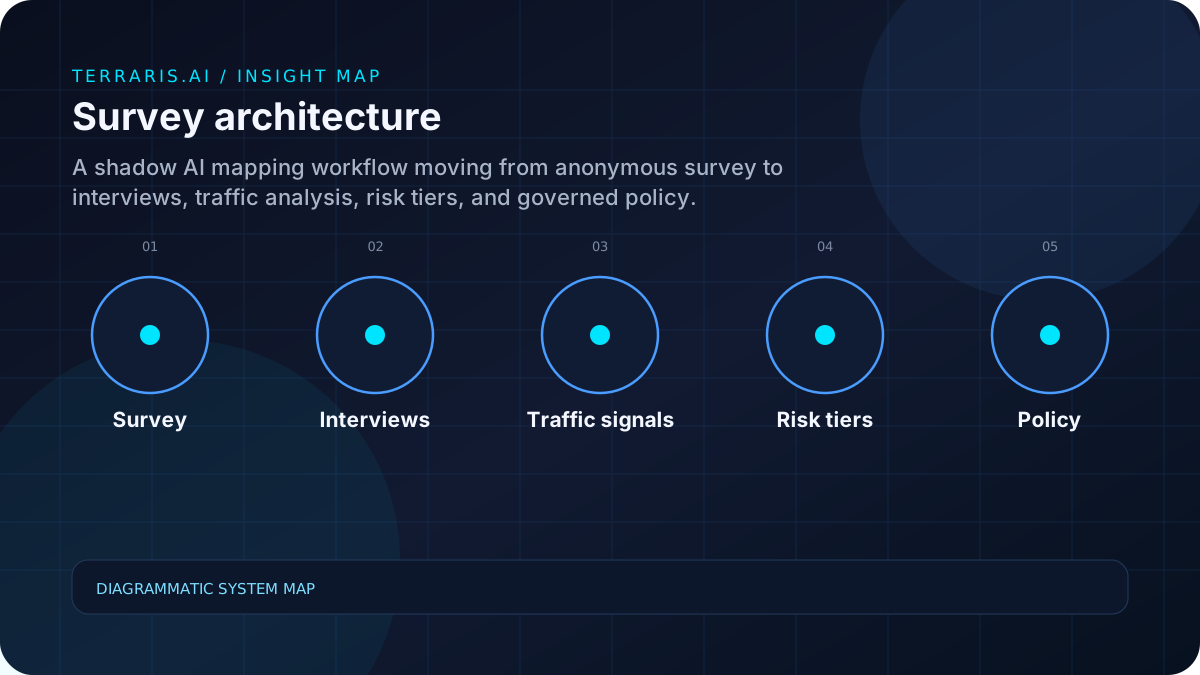
Mapping Shadow AI requires asking different questions than a standard security audit. The goal is not to detect violations after the fact. The goal is to understand where AI is already embedded in work practices, before defining governance policy.
Phase 1: survey. An anonymous survey across the organization asking: which AI tools are you currently using for work tasks, what types of data are you using them with, and approximately how often. Anonymity is critical. If employees expect consequences for honest answers, the survey returns the answers employees think management wants to hear, which are useless for governance purposes.
Phase 2: process walk. For each major workflow, work through the process step by step with the people who do it, and ask: at which points have you found AI tools useful? The process walk surfaces informal tool adoption that employees do not think of as “AI usage” because it is just part of how they work: summarizing long documents, drafting communications, generating analysis code, researching competitive information.
Phase 3: risk classification. For each Shadow AI use identified in phases 1 and 2, classify the data involved by category: personal data in GDPR or LGPD scope, confidential business information, regulated data (financial, healthcare, legal), intellectual property. Then classify the consequence of each use: is this affecting a consequential decision? Is this generating content that will be shared externally? Is this being used to automate a process that has human oversight requirements?
Phase 4: policy design. For each risk tier produced by phase 3, the governance response takes one of two forms: provide a governed alternative that covers the use case with appropriate controls, or establish a clear acceptable use policy that defines what data is permissible in unsanctioned tools and what requires a governed system.
The output of this four-phase process is a Shadow AI register: a documented inventory of unsanctioned AI use, its data exposure profile, and its risk classification. This document becomes part of the AI risk management documentation required under the EU AI Act for organizations with operator obligations, and forms a core component of the AI system inventory required for ISO 42001 certification.
The Data Categories That Create Real Exposure
Not all Shadow AI use carries the same risk profile. The categories that create material legal and regulatory exposure follow a consistent pattern.
Personal data. Employee information, customer records, health-related data, any information that identifies or can identify a natural person. Personal data submitted to public AI tools may be retained and used for model training depending on the provider’s terms of service and the specific tier in use [ESTIMATIVA: terms vary by provider; verify current ToS for each specific tool before citing categorically]. GDPR Article 28 requires a data processing agreement with any processor of personal data. Most free-tier AI tool use does not have a DPA in place.
Confidential business data. M&A information, client contracts under confidentiality clauses, unreleased product roadmaps, pricing strategy, competitive intelligence. The confidentiality obligation to clients and counterparties does not pause because the processing is happening in a convenient tool.
Regulated data. Financial records under various regulatory frameworks, healthcare information under applicable health data regulations, legal matter information under privilege considerations. Each of these categories carries obligations that survive the medium of processing.
Intellectual property. Proprietary processes, trade secrets, unreleased research. The legal status of information submitted to public AI models is not uniformly clear across jurisdictions. The exposure analysis should be done before the data is submitted.
The EU AI Act operator risk deserves specific attention. If Shadow AI use in an organization includes AI systems making or assisting consequential decisions in employment, credit evaluation, or other high-risk categories as defined by the Act, the organization may be operating as an EU AI Act deployer with compliance obligations it is unaware of. The mapping process surfaces this before a regulator does.
From Shadow AI Map to Governed Policy
The governance output of a Shadow AI mapping exercise is not a list of prohibited behaviors. It is a tiered policy framework.
Approved tools: AI systems that have been through security review, have appropriate data processing agreements, and are cleared for use with defined data categories. This tier exists to provide the fast, accessible alternative that prevents employees from reaching for unapproved tools.
Conditionally approved tools with data restrictions: tools that are acceptable for certain data categories and not others. An AI writing assistant that is acceptable for public-facing content drafting but not for processing personal data or confidential client information.
Prohibited uses: specific combinations of tool, data category, and decision type that create unacceptable legal or regulatory exposure. Prohibition without provision of a sanctioned alternative is ineffective, so this tier should be narrow.
The Shadow AI register connects directly to ISO 42001 requirements. The standard requires an inventory of AI systems in use within the organization’s scope. Shadow AI that is mapped but not governed represents a gap in that inventory. Addressing it brings the organization toward the documentation requirements that ISO 42001 certification demands.
The EU AI Act connection is equally direct. Companies that are operators or providers of high-risk AI systems, including through Shadow AI use of public models for high-risk decision support, have obligations under the Act that begin with awareness of which systems are being used for which purposes.
Governance as Capability Unlock
Shadow AI mapping consistently surfaces the highest-value use cases in the organization, because the use cases employees reached for unsanctioned tools to solve are the ones where the productivity gap was most acute. The governance work does not eliminate those use cases. It converts them from liability into capability.
The companies whose AI-First initiatives have reached genuine production deployment share a characteristic: they mapped Shadow AI usage rather than ignoring it. The mapping told them where employees had already found AI value. The governance made those use cases sustainable.
The companies treating EU AI Act compliance as a constraint on AI adoption have the causality backwards. Governance is what makes AI adoption durable. The organizations that wait until regulators require documentation will do that work reactively, under pressure, likely after an incident.
Mapping Shadow AI before it maps your organization is not a compliance exercise. It is the discovery process that tells you where AI is already working, and what it will take to make that work last.
Our AI Opportunity Sprint includes Shadow AI mapping as a standard component. The discovery phase produces a risk-classified AI use inventory before any implementation scope is defined.