
ISO 27001 did not change enterprise software procurement overnight. It changed it gradually, then suddenly. In the mid-2010s, requiring ISO 27001 was a differentiating procurement question. By the early 2020s, it was a table-stakes RFP requirement. Vendors without it were removed from consideration in regulated industries before the technical evaluation began.
The same trajectory is playing out for AI governance. ISO 42001, published in November 2023, is at the early-adopter stage of the same adoption curve. Not yet universal. Not yet required in standard enterprise contracts. But the leading edge of enterprise procurement, financial services, healthcare, public sector, regulated manufacturing, is already asking for it.
The window to be visibly early is not infinite. Early movers certify in 2026 and put it on every proposal. Late movers certify in 2028 and explain why it took them two years longer than their competitors.
Why a Certifiable AI Standard Matters Now
The problem ISO 42001 solves is not technical. It is credibility.
Every company offering AI services in 2026 claims to take governance seriously. The claims are not distinguishable by content, because the language of AI governance, responsible AI, ethical AI, safety-first AI, has become a marketing dialect rather than a substantive commitment. Procurement committees have learned to discount the language. They cannot discount a third-party certification from an accredited auditor.
ISO 27001 became procurement-relevant because it converted an unverifiable claim, “we take information security seriously,” into a verifiable fact, “an accredited third party has audited our management system against an international standard.” ISO 42001 does the same conversion for AI governance.
The first-mover advantage compounds. Early certifiers build their governance documentation, internal audit cadence, and management review processes into their operational rhythm. Late movers build the same infrastructure under deadline pressure, usually after a procurement loss that makes the urgency visible. The companies that lead the certification curve develop institutional capability. The companies that follow are checking a box.
What ISO 42001 Actually Covers
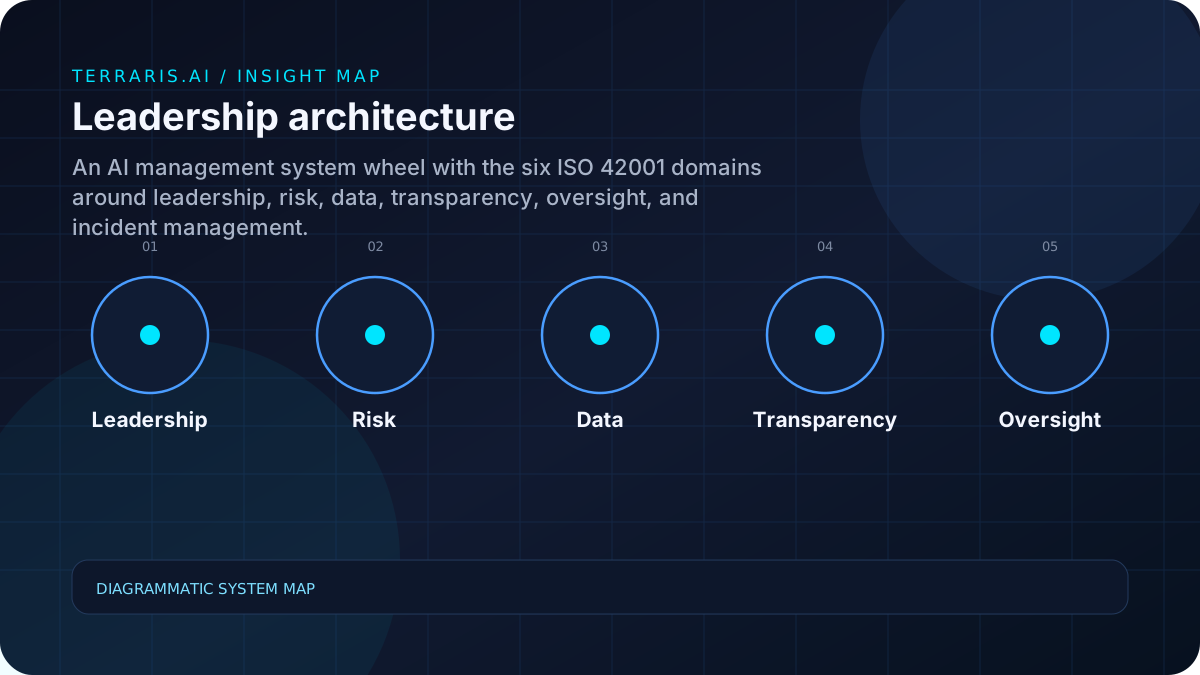
The standard establishes an AI management system (AIMS), analogous in structure to ISO 27001 for information security or ISO 9001 for quality management. It covers six key domains.
Leadership and AI governance policy. Top management must define the organization’s AI policy, establish roles and responsibilities, and ensure the governance structure is resourced and reviewed. This is not a technical requirement. It is an organizational commitment requirement.
Risk assessment and treatment. For each AI system in scope, the organization must document the risks, assess their likelihood and impact, and define treatment plans. The risk register for AI systems is the core operational document.
Data governance for AI. The standard requires documented policies and controls for the data used in AI system development and operation: data quality, data access controls, data lifecycle management, and bias assessment processes. This is where the context architecture work that AI-First implementations require intersects with the governance requirements.
Transparency and explainability. Organizations must document what AI systems do, what their limitations are, and what information is provided to users who interact with them. For external-facing AI systems, this documentation is part of the basis for EU AI Act compliance.
Human oversight mechanisms. The standard requires that consequential AI decisions have defined oversight mechanisms: who reviews AI outputs in high-stakes situations, what escalation paths exist, and how human judgment is preserved in areas where the AI system’s reliability is insufficient for autonomous operation.
Incident management for AI failures. Unlike software incidents, AI failures are often gradual, not acute. The standard requires processes for detecting AI system degradation, logging anomalies, investigating root causes, and implementing corrections. This is the operational governance that converts a data loop from a technical concept into an auditable practice.
The standard is technology-agnostic. It governs how you manage AI, not which AI you use. This means the certification applies across the organization’s entire AI footprint, including the Shadow AI use that mapping exercises surface.
The ISO 42001 + EU AI Act Intersection
The EU AI Act and ISO 42001 are distinct regulatory instruments from different bodies. They are also structurally complementary.
The EU AI Act requires conformity assessment for high-risk AI systems before deployment. Conformity assessment requires technical documentation, risk management processes, data governance records, and evidence of human oversight mechanisms. ISO 42001 certification generates all of these as standard documentation outputs.
The certification does not substitute for EU AI Act conformity assessment. It accelerates the documentation work that conformity assessment requires, and it provides external audit validation of the management system behind that documentation. For a company pursuing both simultaneously, the efficiency gain over sequential implementation is material.
For Brazilian operations of European companies, ISO 42001 aligns with the direction of ANPD guidance on AI governance under LGPD [ESTIMATIVA: vault research references ANPD in this context; specific ANPD guidance on ISO 42001 alignment requires validation before publishing as a confirmed claim]. The underlying governance principles, risk assessment, data governance, transparency, oversight, are consistent with LGPD’s data protection requirements applied to AI systems.
The Gap Analysis — What Most Companies Are Missing
The most common finding in a preliminary ISO 42001 gap assessment is not catastrophic governance failure. It is the absence of documentation for practices that exist informally. Most companies have someone who reviews AI outputs before consequential decisions are made. Nobody has written down that this is required, who is responsible for it, or what the escalation path is. The practice exists. The governance record does not.
The five gaps that appear most consistently:
AI system inventory. Which AI systems does the organization develop, provide, or use? Including the internal tools, the vendor-provided solutions, and the Shadow AI that mapping has not yet formally documented. ISO 42001 requires this inventory as a foundation for everything else.
AI risk register. For each system in the inventory, a documented risk assessment: what can go wrong, how likely is it, what is the impact, and what controls are in place. Most organizations have general risk registers that do not address AI-specific failure modes.
Human oversight documentation. The defined oversight mechanisms for consequential AI decisions. Not just the practice, but the documented policy, the designated roles, and the review cadence.
Transparency documentation. What information is provided to users who interact with external-facing AI systems? This is frequently undocumented even when the practice of providing some disclosure exists.
AI incident management process. A specific process for AI failures, separate from general IT incident management. AI failures require different root cause analysis, different remediation approaches, and different communication to affected parties than software bugs.
None of these gaps represents advanced governance work. All of them require documentation discipline and management commitment rather than technical investment.
The Implementation Path in Practice
A focused ISO 42001 implementation at a mid-size organization typically runs across four phases [ESTIMATIVA: editorial synthesis based on ISO management system implementation analogues; actual timelines vary by organization complexity].
Phase 1 (4-6 weeks): scope definition, AI system inventory, and gap analysis against ISO 42001 clauses. The scope question, which AI systems and organizational units are in scope, is the first decision with real consequences.
Phase 2 (8-12 weeks): policy documentation, risk register development, data governance updates, transparency templates, and oversight procedure formalization. Most of the labor is writing down and formalizing practices that already exist informally.
Phase 3 (4-8 weeks): implementation review, internal audit, and management review. The management review produces the formal record that top management has reviewed AI governance performance.
Phase 4: external certification audit by an accredited certification body.
Total timeline: 6 to 9 months for an SME with moderate AI system complexity [ESTIMATIVA]. The cost driver is documentation labor and audit fees, not technology. Governance is an organizational capability, not a technology purchase.
The Contrarian Argument Against Waiting
The ISO 27001 argument from 2010 is the clearest analogue for what is happening with ISO 42001 in 2026. In 2010, the enterprises that resisted ISO 27001 because regulations had not yet required it were making a calculation: why pay for governance before it is mandatory?
Those companies are still paying for it, in a different way. They built information security practices without a management system framework. When ISO 27001 became a procurement requirement, they had to retrofit documentation, audit cadence, and management accountability onto practices built without those requirements in mind. The retrofit is consistently more expensive and more disruptive than building the management system from the start.
Governance built during implementation, as a design requirement rather than a retrofit, costs a fraction of governance added to running systems. The technical debt analogy applies: governance debt accumulates interest.
The AI governance moat argument: competitors building AI-First strategies without governance documentation are building systems that will be increasingly difficult to sell into regulated enterprise procurement as the ISO 42001 adoption curve advances. The companies that lead the certification curve accumulate a self-reinforcing advantage: governance documentation feeds the sales process, the sales process funds continued AI investment, continued AI investment generates more governance evidence.
ISO 42001 is not an insurance policy. Insurance covers losses after they occur. The certification is a market positioning tool for companies that sell AI systems and services to regulated enterprises, and it is available now, at a point when early certification is still genuinely differentiated rather than merely compliant.
Terraris.ai builds ISO 42001 alignment into every engagement from the first sprint. Governance documentation, risk registers, and oversight mechanisms are deliverables, not afterthoughts. Start with the AI Opportunity Sprint.