

The pattern is consistent across industries and company sizes. Executive enthusiasm, a vague problem statement, six months of build time, and then the quiet acknowledgment that nobody is actually using the thing. Or worse, they are using it, but for the wrong tasks, and the ROI conversation becomes uncomfortable.
The failure almost always traces back to the same root cause: the diagnostic phase was skipped because it felt like delay.
A structured discovery sprint, typically run over 30 days [ESTIMATIVA: editorial framing for a focused engagement, not an industry benchmark], removes more risk than 12 months of iterative development on the wrong problem. The counterintuitive reason is that AI itself acts as a load test. When you seriously map which processes to automate, you discover which organizational structures actually hold weight and which ones depend on bureaucratic theater. That discovery changes the implementation entirely.
AI Implementations Fail Before They Start
The failure mode is not complicated to describe. A business unit identifies something that feels like an AI opportunity, usually because a competitor announced something or because an exec attended a conference. A vendor or internal team proposes an implementation scope. The scope is defined around the visible surface of the problem, not its root. Six months and a significant budget later, the system solves the stated requirement but not the actual need, and adoption is thin.
The more subtle version: the implementation succeeds technically but lands in a process that was already broken. AI accelerates broken processes. It does not repair them. A fast broken process is sometimes worse than a slow one, because the speed obscures the dysfunction.
The structural cause in both cases is the absence of a real diagnostic. The team accepted a problem definition from whoever had the budget to sponsor the project, rather than interrogating whether that problem was the one worth solving. The diagnostic sprint interrogates that assumption deliberately, before any build costs are incurred.
What a Discovery Sprint Produces
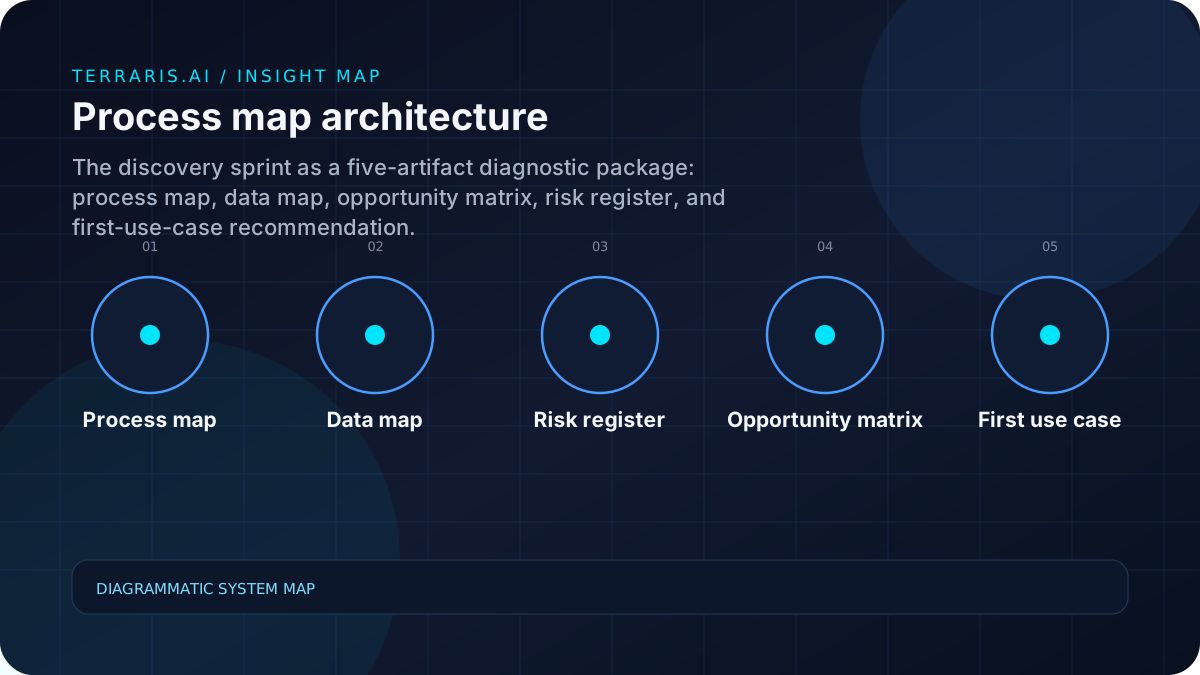
A paid discovery sprint should generate four minimum artifacts. Not slides, not a roadmap, not “opportunities to explore.”
A process and data map for each candidate workflow: the process owner, the systems involved, the data inputs and outputs, the frequency, the estimated cost of failure, and the current error rate. This is the map of what the organization actually does, which frequently differs from what it thinks it does.
An opportunity matrix that evaluates each candidate process across four dimensions: potential impact if the AI works as intended, effort required to build and maintain it, quality and accessibility of the data it would depend on, and degree of human judgment required at each decision point. The matrix produces a ranking, not a recommendation, because the ranking still needs to account for organizational readiness and executive sponsorship.
A pilot design for the highest-ranked opportunity: a defined before-and-after metric, the guardrails that would prevent the AI from causing damage while the system is unproven, and explicit go/no-go criteria. The pilot design forces specificity about what “working” means, which is often the most valuable conversation the sprint produces.
An executive recommendation with six possible conclusions: build now, wait for better data, buy an existing tool instead of building, improve data quality first, train the team instead, or abandon the opportunity entirely. A good discovery produces “don’t build this” as the output for roughly every third engagement, in typical experience [ESTIMATIVA: commercial thesis from observed engagements, not external benchmark]. That honesty is what distinguishes a diagnostic from a sales process.
The Loadbearing AI Lens
Alex Karp, CEO of Palantir, has made an observation worth taking seriously: AI reveals the real market value of work. Tasks that looked valuable because they were hard become transparent when AI can accomplish them in seconds. The value was not in the task. It was in the person who had learned to do the difficult thing.
When applied to organizational process mapping, this reframe is uncomfortable and useful. You are not just asking which processes AI can assist. You are asking which processes are structurally loadbearing, and which ones appeared to be loadbearing because they were time-consuming.
The sprint maps each candidate process by real decision frequency, data availability, exception rate, and human judgment dependency. The combination produces a signal about what the process is actually doing in the organization. High decision frequency, low exception rate, available data, and minimal judgment dependency is the automation candidate profile. High exception rate with significant judgment dependency is the advisory use case. Low frequency with high judgment is typically not an AI project at all.
The more consequential discovery is identifying the informal process stewards, the people who actually carry organizational load without titles or systems that reflect it. These are the individuals whose workarounds, institutional memory, and judgment are what actually make the process function. A discovery sprint that misses them misses the real architecture.
The Five Signals That Qualify a Process
Five conditions determine whether a process is worth pursuing in a first AI engagement. Four out of five produces a difficult first client. All five must be present.
Pain is linked to measurable money or risk. “This takes too long” is not sufficient. “This is costing X in revenue per quarter” or “this creates Y in compliance exposure” is sufficient. The metric does not need to be perfectly precise, but it needs to exist and be ownable.
Data exists and is accessible. Not locked in vendor systems. Not stored in unstructured PDFs from 2017 that nobody has touched since. Not living in the head of the one person who has been running the process for eight years. Data that can be queried, structured, and made available to the AI system.
The decision maker is reachable. The person with authority to approve implementation, restructure the process, and resource the project is someone who will engage in a few focused sessions. Sponsorless projects lose priority before the first sprint is finished.
The first project creates a path to continuity. The pilot should naturally open into an ongoing improvement system. If the implementation has a clean end state with no ongoing value, the economics for both parties are weak.
Money is already flowing in the process. The “money waits” filter: if the process is touching revenue, reducing cost, or managing risk that has real financial consequence, the ROI conversation happens naturally. If it is not, even a successful implementation struggles to earn renewed commitment.
Checking these five conditions takes less than a day of focused conversation. Not checking them takes twelve months to discover empirically.
What Discovery Looks Like in Practice
The mechanics are straightforward: three to five stakeholder sessions, structured as process walkthroughs rather than interviews. The goal is to follow the actual work, not the official description of it.
Each session maps the workflow from trigger to output: what starts the process, what decisions are made along the way, what can go wrong at each step, what the exception-handling looks like, and what the system of record is for the outcome. The data audit runs parallel: where is the data, who owns it, what format is it in, what is the access model.
The output documentation is a process flow, a data schema sketch, a risk map listing the categories of harm a poorly performing system could cause, and a guardrails list defining what the system should never do without human review.
The most valuable moment in a discovery sprint is when the practitioner tells the client “this should not be AI.” That conclusion can mean the process needs better software, that it needs a cleaner data structure first, or that it depends on judgment that is not yet replicable at the required quality level. Each of those is a more honest and more useful output than a scope that leads to a failed implementation. The honesty builds more durable trust than a proposal that tells the client what they want to hear.
Pricing the Discovery Right
Free discovery trains clients to treat diagnostic capacity as a sales cost. The message it sends is that the diagnosis has no independent value, that it only matters as a lead into implementation, and that the practitioner is not confident enough to charge for the work until they know the client will buy more.
A paid discovery signals the opposite: the diagnostic has value regardless of what it recommends. If it recommends not building, the client still made a better decision than they would have made otherwise. That outcome is worth paying for.
The fee also functions as a filter. Clients who will not pay for a structured diagnostic before a significant AI investment are signaling something about how they will engage with the implementation. A client who resists paying for 30 days of risk reduction before committing to 12 months of build is a client whose implementation will likely be painful regardless of technical quality.
The commercial sequence that works: discovery as the first engagement, production MVP as the second, AI partner retainer as the third [ESTIMATIVA: commercial thesis from observed engagements]. Each step is paid, each has a defined output, and the retainer only makes sense after the discovery has validated that there is something worth building and maintaining.
Our AI Opportunity Sprint is a structured 30-day diagnostic that produces the four artifacts described above. It ends with a recommendation a CEO can act on, not a slide deck full of potential.