

Most AI initiatives fail not because the technology doesn’t work. They fail because the organization was never restructured to use it.
The company bought an enterprise LLM license, ran a few workshops, shipped a chatbot, and called it AI-First. Six months later, the chatbot handles 3% of the use cases it was supposed to. The rest of the organization kept working exactly as before, except now there’s a line item in the budget and a deck about “digital transformation” collecting dust in a shared drive.
The technology was never the constraint. The org was.
The Difference Between an AI-First Individual and an AI-First Organization
Cassie Kozyrkov draws a line worth internalizing: an AI-first individual uses models as cheap advice engines, one task at a time. An AI-first organization is different in kind, not degree. It requires executive priority, a change vision, and a concrete hypothesis about previously impossible capacity.
The distinction matters because most companies are full of AI-first individuals operating inside organizations that are structurally not AI-first. A hundred employees using ChatGPT to draft emails does not make the company AI-first. It makes it a company with a hundred individuals finding workarounds because the official process is slower than a public tool.
The mistake executives make is assuming that personal productivity gains compound automatically into organizational transformation. They don’t. Compounding requires redesigned processes, realigned decision rights, and deliberate context architecture. Without those three things, individual efficiency gains stay individual.
Aaron Levie, CEO of Box, has mapped this with a matrix most practitioners recognize on sight: task repetition on one axis, reasoning complexity on the other. The quadrant that matters for genuine AI-First transformation is high repetition combined with high reasoning, not the easy automation wins that appear elsewhere. Sales enablement, contract analysis, customer success, product research. The work that costs people real hours and carries real risk if it goes wrong.
What AI-First Actually Requires Organizationally
Decision rights are the first structural question that most AI transformations skip. Who approves an agent action? Who owns the process the agent touches? Who escalates exceptions when the output is wrong? Without explicit answers, agents surface in production with nobody clearly accountable, and the first significant error creates paralysis rather than improvement.
Headcount design is the second. An AI-first company asks “which part of this new role can be AI-assisted before we hire” as a standing design question, not as a cost-cutting exercise. The distinction between those two framings determines whether the organization builds genuine capability or just creates resentment. Redesigning work with AI in mind from the start produces very different hiring outcomes than trying to retrofit AI onto headcount after the fact.
Process redesign before automation is the third. The standard error is automating the existing workflow. Automating a poorly designed process produces a faster version of the same bad outcome. The AI transformation that generates real return is the one where the company first asks: if we were designing this process today with AI in the room from the beginning, what would it look like? The answer is usually shorter, cleaner, and involves fewer handoffs.
Context architecture is the fourth and least-discussed organizational requirement. A model answering from generic internet training is not an enterprise AI system. It is an expensive demo. The enterprise AI system gets its leverage from the documents, policies, contracts, win-loss data, support tickets, and historical decisions the organization has accumulated over years. Who owns that corpus? Who controls access? Who is responsible for keeping it current? Without answers to these questions, the context that would make the agent actually useful stays fragmented, outdated, or locked in systems nobody can query.
The Repeatability x Critical Thinking Matrix in Practice
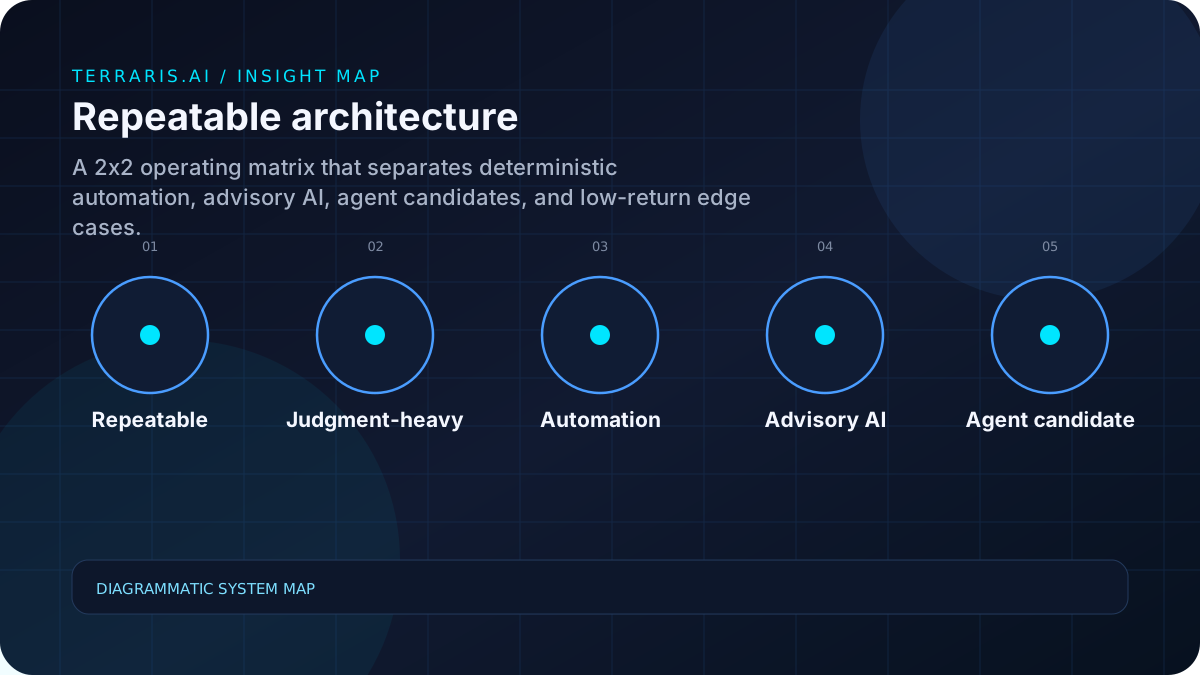
The quadrant analysis provides a practical filter for where to start.
Low repetition, low reasoning: no AI project worth running. This is the territory of edge cases and one-offs. The return on building infrastructure for problems that appear twice a year is negative.
High repetition, low reasoning: deterministic automation, not agents. If the decision tree is simple and the volume is high, build a rule engine or a structured workflow. Reaching for an LLM here adds cost and brittleness without adding capability.
Low repetition, high reasoning: advisory, not autonomous agent. This is where senior judgment matters and AI can accelerate research, surface relevant precedent, or draft options. The agent should be in the loop, not running it.
High repetition, high reasoning: this is the AI-First target. Sales qualification, contract review, customer success escalation triage, competitive intelligence summarization, regulatory monitoring. These processes carry real business weight, run at volume, and require genuine judgment each time. They are also the processes where organizations have typically accepted that good enough is the best they can do, because the cost of doing it properly at scale was too high. AI changes that constraint.
The discipline is refusing to start with the easy quadrants and declaring victory.
The Quarterly Cadence That Sustains AI-First
A transformation announced once and then left to individual initiative will not compound. It will plateau at the level of the most motivated individuals and then decay as priorities shift.
AI-First needs to become a management rhythm. Each business area proposes one AI initiative per quarter: the problem it addresses, an impact-effort matrix, a defined experiment with measurable before-and-after, and criteria that determine go or no-go. The bar is not “this is interesting.” The bar is “this produces a measurable change in revenue, risk, or capacity.”
The second discipline is the headcount question, applied before approving any new hire or vendor engagement: which part of this work can AI assist, amplify, or reduce? David Friedberg frames this as the redesign obligation that precedes the purchase decision. If the answer is “none,” proceed. If the answer is “some,” design the role and the tool together. If the answer is “most,” the question becomes whether the hire is actually needed, or whether the capacity can be built differently.
Neither question is about cutting. Both questions are about designing forward rather than adding capacity on top of structures that were built for a world without AI.
Why Context Is the Real Moat
The same GPT-4o that gives generic answers to a consumer query can drive sophisticated contract analysis, competitive positioning, or regulatory interpretation when given the right context. The difference between those two outcomes is not the model. It is the context architecture.
Companies that win the AI-First transition in 2026 and 2027 will not necessarily have access to better models. They will have better context: proprietary process documentation, curated decision libraries, institutional knowledge that has been structured and made queryable. The model is commoditizing fast. The internal context corpus is not.
This means the AI-First strategy conversation is really a data and documentation strategy conversation dressed in different clothes. Who is responsible for maintaining the documents and policies that would make an AI agent reliable in production? What is the process for updating that context when the business changes? Who audits the outputs to detect context drift?
These are not technology questions. They are organizational design questions with technology consequences.
The Organizational Change You Cannot Skip
Every major AI-First transformation effort has two versions of the story leadership can tell. One is about cost: AI will allow us to do more with fewer people. The other is about capacity: AI will allow us to do things we were previously not able to do at all.
The first story creates resistance, incentivizes shadow behavior, and generates small use cases. People optimize to protect their roles, not to build new capability. The second story creates different dynamics. When the framing is “what products, campaigns, analyses, or decisions were previously impossible with your existing headcount,” the conversation changes. People start surfacing the work that falls through the cracks, the decisions that never get reviewed properly, the analysis that only happens when someone has spare hours.
Org change is not a soft skill. It is an engineering constraint on what AI can actually deliver in practice. A technically excellent AI system deployed into an organization that hasn’t changed its decision rights, its incentive structures, or its process design will underperform consistently. Not because the technology failed, but because the organization was never restructured to absorb it.
The companies that are building real AI-First capability right now are not necessarily the ones with the best models or the biggest budgets. They are the ones that treated “AI-First” as an operating model decision made in the boardroom, not a vendor selection made in the technology department.
Terraris.ai runs structured AI Opportunity Sprints that diagnose operating model readiness before any implementation begins. The sprint surfaces the decision rights, context architecture, and process design questions that determine whether AI delivers or stalls.