

Every vertical AI pitch eventually becomes a platform pitch.
The sequence is predictable: we will solve problem A, and once that works, we will add B, and C, and D, and become the operating system for this industry. The platform narrative is compelling because it explains why a narrow initial market is acceptable and promises massive eventual scale. It is also the story that most vertical AI projects tell before they quietly stop being used.
The trap is structural. Platform ambitions require breadth. Breadth requires resources. Resources require revenue. Revenue requires a single thing that works well enough for someone to pay for it now. Most projects fail between the initial demo and the first thing that actually works in production, not because the platform vision was wrong, but because nothing narrow ever shipped.
The Platform Trap
The platform pitch survives as long as the demo does. A well-prepared demonstration of what the system will do when all the components are assembled is not hard to produce. It is hard to ship.
The gap between what was demonstrated and what is in production is the implementation reality of each component that was assumed to be straightforward: data integrations that require custom connectors, edge cases that the demo did not expose, latency requirements that differ from demo conditions, governance requirements that were not modeled, and users who interact with the system differently than the personas in the planning deck.
Platform ambitions compound this gap by multiplying the number of components that must work simultaneously. A single solved problem has one gap to close. A platform has many.
The question worth asking before the next planning cycle: what is the one problem this project can solve reliably, measure clearly, and prove to a paying customer this quarter? Not this year. This quarter.
The Minimum Viable Vertical
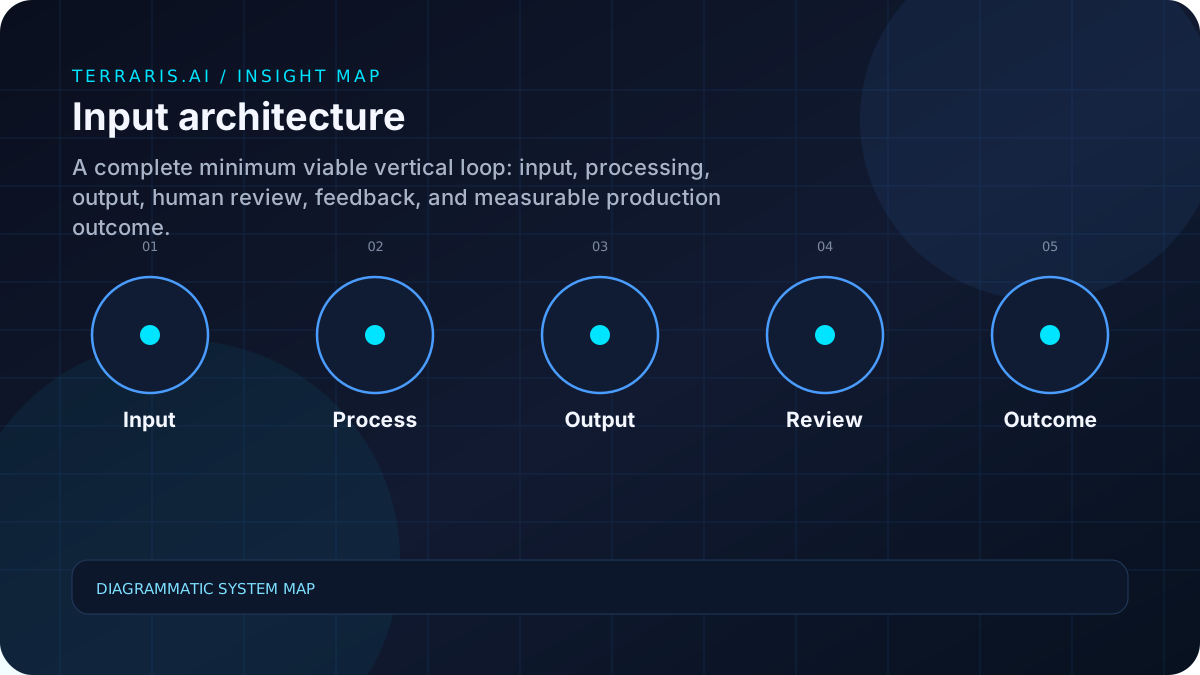
What actually survives the gap between demo and production is not a platform. It is a minimum viable vertical: a single process, solved reliably, with a clear before-and-after metric, deployed in production with real users.
A minimum viable vertical is not a feature. It is a complete loop: input, processing, output, a human review gate where the stakes require it, a feedback mechanism when the output is wrong, and a measurement of whether the output was correct. All five components are present before launch, not added iteratively after.
Narrowness is an advantage here, not a limitation. A system designed to do one thing can be evaluated on clear criteria. Edge cases are bounded. Training data and retrieval corpora can be curated specifically for the problem. The subject-matter expert who validates output is identifiable and accessible.
The expansion logic that follows a solved minimum viable vertical is fundamentally different from starting with platform ambitions. The team knows what good looks like from the first use case. There is an evaluation harness. The failure modes of the narrow system are documented. Extending to an adjacent problem is an informed decision, not a fresh bet.
The Ghost Town Pattern
There is a recognizable pattern in vertical AI deployments that fail without a dramatic shutdown: the ghost town.
The system was built, demonstrated, and then quietly stopped being used. It may still be running. The lights may still be on. But the decision owners who were supposed to act on its output have reverted to previous methods, or the system has been routed around, or it continues to generate recommendations that nobody reads.
Ghost towns do not form because the technology failed. They form because validation failed. The use case was never tested against the money-waits criterion: is someone already spending resources, in time or staff or external services, to solve this problem today? If yes, AI that solves it well captures that spend. If no, the question of why AI is the first solution proposed is worth answering before building.
Ghost towns also form when the system was built for a use case the data did not support, when the output was accurate but no decision owner was accountable for acting on it, and when the system worked in controlled conditions but failed on the actual variance of real production data.
The recovery path from a ghost town is not adding features. It is going back to the process map, identifying the one step where the operational pain is sharpest and most measurable, and rebuilding the system around that step alone.
What “Works in Production” Actually Means
Production is not a demo environment with real data. It is a system running under real load, with real variance in inputs, with real consequences when it fails, and with real users who have not read the documentation.
The production checklist for vertical AI includes specifics that are often deferred until after deployment. Latency is acceptable to the actual user workflow, not just to the team that built the system. Error handling is graceful and surfaces failures to the right person with enough context to act. The human review gate is staffed, not assumed. Logs exist and someone reviews them on a schedule. There is a rollback plan if accuracy degrades.
The production gap in most failed vertical AI deployments is that the system was never tested on the actual distribution of inputs, with the actual users, under the actual time constraints of the real workflow. Controlled testing does not surface the variance that production reveals.
The staged rollout pattern addresses this directly. Read-only mode first: the AI provides recommendations, humans act on them or not, and the system’s accuracy is measured against the human decisions. Supervised write mode second: the AI proposes actions, humans approve each one, and the approval rate is tracked as a proxy for trust. Autonomous mode only after the approval rate has stabilized and the failure modes are documented.
This sequence is not conservative caution. It is how trust accumulates in production systems. Moving directly to autonomous mode before the failure modes are documented is how ghost towns start.
The Moat That Actually Accumulates
Platform moats require scale most vertical AI projects never reach. The moat that accumulates before scale is different in kind and accessible through narrowness.
A domain-specific evaluation harness, built from real cases with known correct answers that nobody else has access to, is a competitive asset that cannot be replicated without access to the same domain data and subject-matter expertise. It tests accuracy on the criteria that actually matter in the domain, not on generic benchmarks.
Proprietary training signal, the feedback from real production decisions that flows back into the system, is not replicable. A competitor starting fresh does not have the history of edge cases that were wrong and corrected, the patterns that the operators have validated over months of use.
Integration depth means the system is embedded in the actual workflow. Switching requires rebuilding those integrations from scratch, not just licensing a different model.
Trust is earned by the decision owner who has staked professional credibility on the system’s reliability. That trust is not transferable to a new vendor, regardless of technical capability.
All four moat components compound slowly and defensibly. They are built by shipping one solved problem and instrumenting it well. They are not built by announcing a platform.
Platform as a Consequence
The vertical AI companies that become platforms do so because they solved one problem well enough that customers asked for the adjacent one.
Solve problem A reliably. Instrument it. Build the evaluation harness. Let the customer experience the reliability, and let them ask what else the system could handle. Scope problem B from the discovery findings of what the team learned building A. Apply the same discipline. Repeat until the pattern looks like a platform.
The reverse sequence, platform vision first, then build everything, then find one thing that works, produces expensive write-offs. The economics of building before validating at platform scale are brutal. The economics of compounding one solved problem into adjacent ones are defensible.
The question to ask before the next planning cycle: what is the one process this system solves reliably, that can be measured clearly, that a paying customer would value this quarter? Start there. The platform, if it is real, follows from there.
The minimum viable vertical is not a compromise on ambition. It is the mechanism through which ambition becomes defensible.
Related: Vertical AI Wins Where Generic AI Fails and The Discovery Sprint That Prevents Twelve-Month Vertical AI Mistakes