
A new head of operations joins a manufacturing firm. She wants to understand why a specific supplier was chosen five years ago over three cheaper alternatives. She opens the knowledge base. She finds the supplier contract, the onboarding checklist, the current SLA. What she does not find: the rejected alternatives, the defect data that disqualified two of them, the regulatory constraint that eliminated the third, the name of the person who made the call and the logic they used.
The knowledge base contains the output of the decision. The decision itself is gone.
This is the document indexing fallacy: indexing documents produces a searchable archive of outputs. Organizations do not run on outputs. They run on the reasoning that produced them.
The Document Indexing Fallacy
Standard enterprise knowledge management follows a familiar sequence: collect documents, run them through a vector database or search index, build a search interface, and declare the knowledge base operational. The list of documents that typically gets indexed: approved policies, final contracts, formal procedures, finished reports, product specifications.
These are all outputs. Every one of them is the residue of a decision process that happened upstream. The contract documents what was agreed. It does not document why the competing offer was rejected, what legal risk was traded for the lower price, or which executive overrode the initial recommendation.
When a new employee or an AI agent queries this knowledge base, they retrieve the what without the why. The why is the part that prevents the organization from repeating its own mistakes. The why is the part that explains why the happy-path procedure has a workaround that everyone uses but nobody documented. The why is the part that makes the difference between an organization that learns and one that cycles.
Document indexing is table stakes. Every organization can stand one up in a week. The knowledge that creates durable competitive advantage was never in the documents.
Three Types of Enterprise Knowledge
The distinction becomes clearer with a simple taxonomy.
Explicit knowledge is documented, searchable, and transferable without significant loss of fidelity. Procedures, specifications, contracts, reports. This is what document indexing captures well. It is also the least differentiating type: if it is fully explicit, competitors can build it too.
Tacit knowledge is operational know-how held by practitioners. The workarounds that everyone applies but no one has written down. The heuristics that an experienced field technician uses to diagnose a problem in thirty seconds that a manual would take twenty pages to describe. The account manager’s sense of when a client is about to churn, built from hundreds of small signals over years of relationship. Tacit knowledge is almost never in documents, because it was never articulated at a level of detail that would make documentation worthwhile to the person who holds it.
Decision knowledge is the record of why choices were made. The tradeoffs evaluated, the alternatives rejected, the information available at the time, the person who held accountability and why they weighed the factors the way they did. Decision knowledge is partially in documents: meeting minutes, approval chains, email threads. But it is rarely structured for retrieval in a way that surfaces the reasoning rather than just the conclusion.
Most enterprise AI projects address explicit knowledge and ignore the other two. The organizations building AI systems that are genuinely hard to replace are the ones structuring the capture of tacit and decision knowledge, because those two types are the ones that accumulate organizational intelligence that a competitor cannot replicate by purchasing the same tools.
The Institutional Memory Problem
A domain expert leaves a company. Two things leave with them.
The first is their tacit knowledge. Unless there was a structured extraction effort, this knowledge is irretrievable. The organization does not know what it lost, because the knowledge was never articulated. It discovers the loss when a problem appears that the expert would have recognized and solved in hours, and the team spends weeks on it.
The second is their decision knowledge. This is partially recoverable, if decisions were recorded with context. A decision log that captures what was decided, what alternatives were considered, what information was available, who was accountable, and what outcome was expected, gives future employees and AI agents a map of the reasoning behind the organization’s current state. Without it, new staff repeat analysis that was already done. Decisions get made without knowing they were tried and failed. Regulatory responses lack the context of prior audit findings that would have shaped the approach.
Knowledge engineering for AI is the work of structuring information capture so that tacit knowledge becomes explicit and decision knowledge becomes queryable. The practical methods are not exotic: decision logs with structured context fields, process documentation that includes exceptions and edge cases rather than just the happy path, and expert interviews designed to extract heuristics rather than procedures.
The interview question that unlocks tacit knowledge is not “how does this process work?” It is “what would a new person do that you would immediately recognize as wrong?” That question surfaces the knowledge that experienced practitioners carry implicitly, the knowledge that no procedure manual captures because the person who wrote the manual assumed the reader already knew the exception.
The Context Layer Architecture
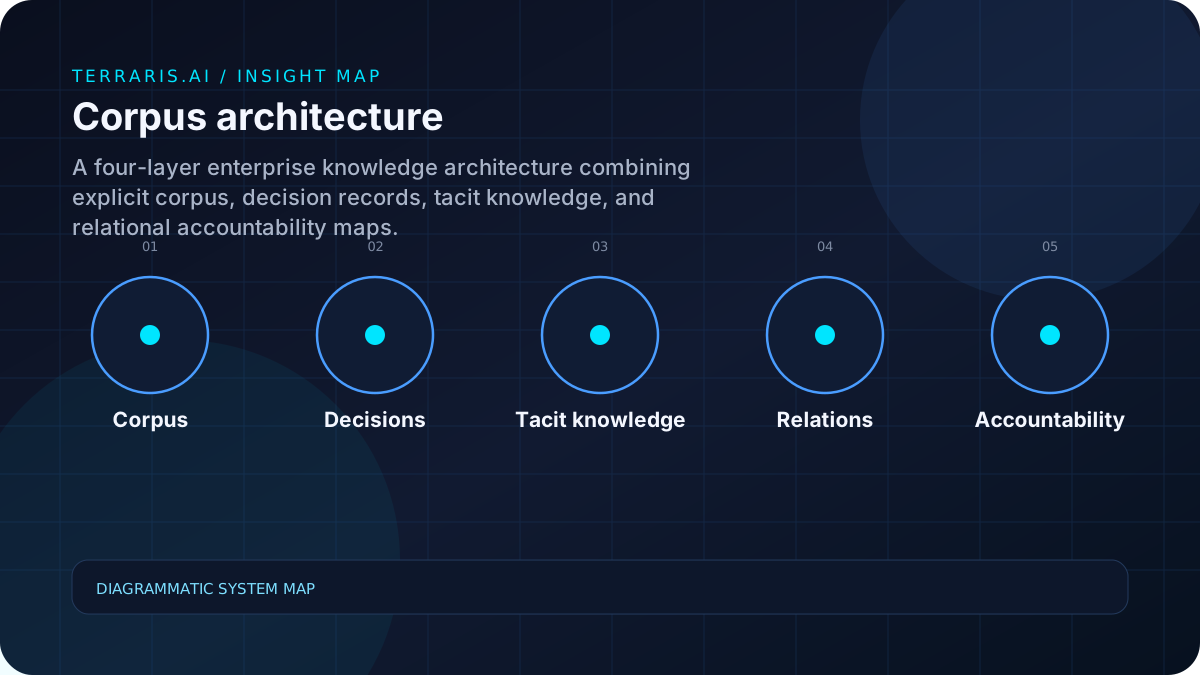
A knowledge system built to support AI agents requires more than a document store with vector search. Vector search retrieves documents that are semantically similar to the query. It does not retrieve the reasoning behind a decision, the relational map of who is accountable for what, or the edge cases that practitioners have learned to handle differently from the written procedure.
The architecture that supports AI-First knowledge systems has four layers.
The explicit corpus is the foundation: structured documents, indexed with metadata, searchable by content and classification. This is what most organizations have.
The decision record is what most organizations are missing: a structured log of significant decisions with context, rationale, and outcome tracking. Each entry captures what was decided, what alternatives were considered, what information was available at the time, who was accountable, and what outcome was expected. The entries are queryable by topic, by decision owner, by time period, by outcome type.
The tacit knowledge capture layer is the product of structured expert interviews, process shadowing, and annotated edge cases accumulated as they occur. This is the layer that requires the most organizational discipline to build, because the knowledge holders rarely have time to articulate what they know, and the organization rarely has the structure to capture it systematically.
The relational map connects people, processes, systems, and responsibilities. Many of the most valuable enterprise queries are not “find me a document” but “who is responsible for X and what constraints govern it.” That is a graph query. A vector database does not answer it. A relational map does.
The distinction between wiki, RAG, and structured knowledge bank is a decision that should follow from the query type, not from the technology preference of the team building the system. Wiki for synthesized understanding across a domain where the knowledge is relatively stable. RAG for document-grounded answers with citations, where the query expects a factual answer tied to a specific source. Structured bank for factual records where filtering by attribute is more important than semantic search. Most enterprise knowledge systems need all three, serving different query types from the same underlying corpus.
Building the Knowledge System That Survives Personnel Turnover
The test for a knowledge system is simple: if the three most knowledgeable people in a domain left tomorrow, how much of their knowledge would remain accessible to the organization?
Most organizations fail this test badly, not because they lack tools, but because knowledge capture was never designed as a system. Documentation happened when people had time, which means it happened for compliance purposes or for onboarding the most junior staff. The heuristics, the edge cases, the decision rationale: none of that got documented because the expert who held it was still there, and documentation of what an expert already knows implicitly is invisible overhead until the expert is gone.
Designing for retrieval changes the incentive. Every significant decision gets a structured record, not because of compliance requirements but because future employees and AI agents need to query it. Every process gets a version that includes exceptions, because the exceptions are often the load-bearing part of the process. Every domain expert interview produces a structured output that goes into the knowledge system, not into the head of the person who conducted the interview.
The data engine principle, attributed to Andrej Karpathy’s articulation of Software 2.0, applies directly: a knowledge system improves as it is used. Queries that fail to return useful results are signals for gaps in the corpus. Corrections to AI-generated summaries are training data for the next version. The system that captures this feedback loop compounds. The system that treats the knowledge base as a static archive does not.
The minimum viable knowledge system for most organizations is narrower than they expect: one process fully documented with exceptions, one decision log format adopted across a single team, one domain expert whose tacit knowledge has been structured and ingested. That is the starting point. The value of starting is that the feedback loop begins, and the loop is where the compounding happens.
Knowledge Engineering as Competitive Infrastructure
Document indexing is table stakes in 2026. Every organization can spin up a vector database, connect it to a document store, and call it an AI knowledge base. The tooling is cheap. The setup time is measured in days.
The competitive differentiation is not in the indexing. It is in what was captured before the indexing. The quality of the decision records. The depth of the tacit knowledge extraction. The relational map that connects people, processes, and responsibilities in a way that answers the queries that actually matter to the organization.
Organizations that invest in knowledge engineering are building the context layer that makes every future AI deployment more capable. The models do not need to be smarter about the internet. They need to be smarter about this specific organization, its specific processes, the specific reasoning behind its specific decisions. That specificity cannot be purchased from a model provider. It is built through the disciplined capture of decision knowledge and tacit knowledge over time.
Knowledge engineering is not a project with an end date. It is an operational capability that accumulates value as long as the organization continues to make decisions. The organizations that understand this are building infrastructure that will be genuinely difficult to replicate. The ones that treat knowledge management as a search quality problem are building something that any competitor can copy next quarter.
The knowledge in your organization that actually determines what you are capable of is not in your documents. It is in the reasoning behind your decisions. Capturing it is an engineering problem. Ignoring it is a strategic risk.
If you are building or evaluating an AI knowledge system, Terraris.ai works with regulated enterprises on the architecture, implementation, and ongoing governance of production AI. Start with a discovery sprint before committing to a platform.