

The organization that deployed AI fastest in 2024 is not the one moving fastest today. It is the one in incident response, working through a hallucinated contract clause sent to a client, a data privacy exposure from an agent with excessive read permissions, or an undocumented AI decision flagged by a regulatory audit.
Speed without governance does not produce competitive advantage. It produces a head start that gets called in.
The Speed Illusion
The organizations racing to deploy AI without governance frameworks believe they are gaining ground. The logic is intuitive: every week spent on governance review is a week competitors are shipping. Move fast, learn from incidents, iterate.
The problem with this logic is that the incident is not instructive. It is expensive. A hallucinated legal clause in a contract sent to a counterparty creates legal exposure before anyone notices it was wrong. A data privacy incident triggered by an agent with access to records it should not have touched involves regulatory notification timelines, legal review, and reputational cost that do not fit into an iteration cycle. A regulatory audit triggered by an undocumented high-risk AI decision creates a remediation obligation that runs backward through the deployment history.
The speed illusion breaks when the governance debt is called in. And governance debt, unlike technical debt, does not accumulate quietly. It accumulates at the rate the AI system makes decisions, until the decision with visible consequences arrives.
The organizations that move fastest on AI in the medium term built governance infrastructure early enough that each new deployment does not require a new governance conversation. Every system deployed into an existing governance infrastructure is faster to deploy, not slower.
What Governance Infrastructure Actually Is
Governance is not a compliance document. It is not a policy statement, a responsible AI pledge, or a list of principles posted on the company website. Governance is operational infrastructure that runs alongside AI systems in production.
The five components of operational AI governance:
Permission model — an explicit specification of who can invoke which AI capability, on which data, with which level of autonomy. Not a general policy. A specific, enforced access control layer that runs at system execution time.
Audit trail — every significant AI decision logged with the context that produced it: the query, the retrieved information, the generated output, the user who initiated it, and the human approver where one is required. Attributable, timestamped, queryable.
Human escalation path — defined triggers for when AI output must be reviewed by a human before any action follows from it. Not “use your judgment.” A specific list of output types or confidence thresholds that route to human review before the AI action executes.
Incident response playbook — what happens when an AI system produces a harmful output. Who is notified, in what order, in what time window. What the rollback procedure is. Who has authority to shut the system down. Documented before the first incident, not assembled during it.
Model change management — a protocol for evaluating capability and risk changes when the underlying model updates. A model upgrade that adds agentic write capability to a system previously deployed as read-only is a governance event, not a routine software update.
None of these components requires a complete governance framework before deploying the first AI system. Each is buildable incrementally. Each reduces the risk surface of the next deployment.
The Governance Gap in the Frontier Economics
Frontier model providers produce capability faster than most enterprises can absorb it safely. This is Dario Amodei’s framing of the defining risk of the current period: the gap between what the technology can do and what institutions can safely absorb is not a function of malevolence. It is a function of the rate at which organizational learning, regulation, and coordination lag capability development.
For enterprise AI architects, the governance gap is a practical design problem. A model release that adds agentic capabilities to a platform previously approved for read-only use can turn a governed system into an ungoverned one overnight, without any action by the enterprise’s technical team. A vendor upgrade that changes the model version, expands the context window, or adds tool-use capability without announcement introduces new risk surface into a system the organization believed it understood.
The governance design principle that follows: governance must anticipate capability, not react to it. Every governance design should include the question, asked explicitly, “what would governance need to look like if this system were more capable than it is today?” The answer to that question is what needs to be designed now, not after the capability arrives.
The EU AI Act as Governance Accelerator
The EU AI Act is not a compliance burden for organizations that were already planning to govern AI systems responsibly. For well-governed organizations, the Act provides something more useful: a framework that justifies governance investment to boards and procurement committees without requiring a detailed internal argument.
The risk classification logic is direct. Unacceptable-risk systems are prohibited. High-risk systems — those affecting employment decisions, credit scoring, biometric identification, critical infrastructure management, law enforcement — require conformity assessment, human oversight, transparency obligations, and logging requirements before deployment. Limited-risk systems (chatbots, synthetic content generators) require disclosure. Minimal-risk systems face no mandatory requirements.
The competitive implication for regulated industries: demonstrable compliance with EU AI Act requirements for high-risk use cases is a procurement advantage. In financial services, healthcare, and government contracts, the question “can you provide documentation of AI governance conformity” is increasingly part of the vendor evaluation process. Organizations that built governance infrastructure in 2025 answer that question in hours. Organizations that begin governance in response to a procurement request answer it in months.
ISO 42001:2023, the AI management system standard, provides a certification path analogous to ISO 27001 for information security. Organizations seeking to demonstrate governance maturity beyond self-declaration have a certifiable framework available. The existence of the standard also provides a structured roadmap for organizations building governance incrementally — each control domain in the standard corresponds to a buildable component of the governance infrastructure described above.
Governance as Speed Infrastructure
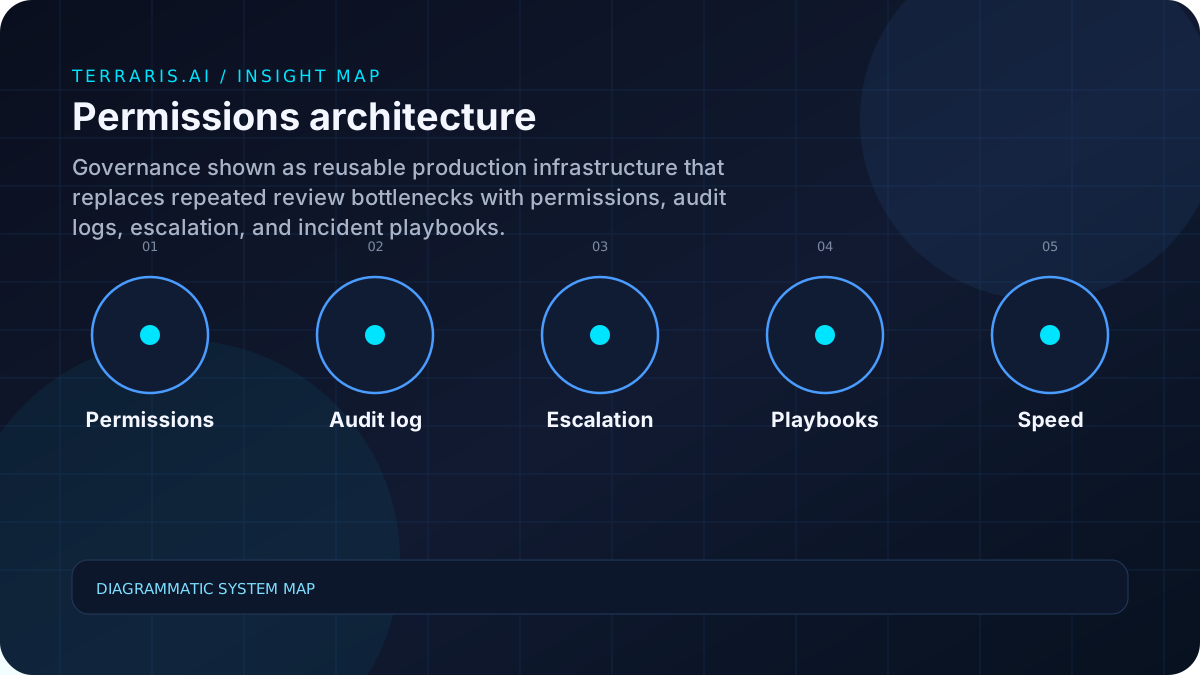
The apparent tension between governance and speed dissolves when governance is implemented as infrastructure rather than as a review process.
Review-process governance: every AI deployment triggers a separate governance review. Each review requires assembling the relevant stakeholders, reviewing the use case against policy, and approving the deployment. The review takes weeks. The backlog grows. Governance becomes the primary bottleneck in the AI deployment pipeline.
Infrastructure governance: the permission model, audit logging, human escalation paths, and incident response playbook are pre-built, tested components. Each new deployment plugs into existing governance infrastructure rather than commissioning new governance from scratch. The deployment team answers a checklist, configures the deployment within the existing permission model, and inherits audit logging automatically.
The speed dividend is measurable: an organization with governance infrastructure can deploy a new AI system in a governed manner faster than an organization without it can complete an ungoverned deployment and survive the subsequent audit. The governance infrastructure is not a gate. It is the road.
The analogy holds from adjacent domains. Organizations with mature information security practices do not deploy software slower than organizations without security infrastructure. They deploy faster, because the security controls are embedded in the development and deployment pipeline rather than added at the end.
The companies that will move fastest on AI in 2027 are not the ones that shipped the most ungoverned systems in 2025. They are the ones that built the governance infrastructure in 2025 that lets them ship governed systems in hours.
The Contrarian Position on AI Safety Investment
AI governance investment is not a cost center. It is the infrastructure that makes the AI program commercially viable at scale.
The financial argument: a single AI incident in a high-risk use case, affecting an employment decision, a credit determination, a healthcare recommendation, or a legal document, carries regulatory, legal, and reputational costs that dwarf the cost of the governance infrastructure that would have prevented it. The cost of prevention compounds negatively from the moment the incident is discovered.
The strategic argument: clients in regulated industries will not procure AI-dependent services from vendors who cannot demonstrate governance maturity. The AI program without governance is structurally excluded from the most valuable enterprise contracts. The governance investment is not optional for organizations that plan to sell to regulated buyers.
The practical starting point requires only three things before the first deployment:
A permission model that is explicit from day one — not “users can access this system” but “role X can query dataset Y with write permissions scoped to action Z.”
An audit log that runs from the first user query — not added after the first incident.
A human escalation path defined before the first output — not improvised when a user receives a response that requires human judgment before action.
Three components. None requires a completed governance framework. All require the decision to build them before the system goes live, not after it does.
Terraris.ai builds operational AI governance that accelerates deployment rather than blocking it. Contact us to scope a governance sprint.