

The most common executive AI strategy in 2026: buy the tools employees ask for, mandate adoption through OKRs, report AI usage statistics to the board, declare the organization AI-First. It is a coherent sequence of decisions. It does not produce an AI-First company.
It produces an AI-cluttered company — one with a growing portfolio of independently useful tools that do not compound, a fragmented knowledge landscape where each platform maintains its own silo, and usage metrics that measure activity rather than outcomes.
The Tool Accumulation Trap
There is a simple test for whether an AI tool portfolio is delivering strategic value or producing the appearance of it: remove the tools and measure the productivity impact after thirty days. If the impact is proportional to the usage metric, the tools were producing outcomes. If the impact is negligible, the tools were producing activity.
Most AI tool portfolios fail this test because the tools operate at the level of individual tasks — a slightly better draft, a faster summary, a marginally quicker search — without any structural change to the underlying process. The productivity gain is real but it does not compound. The tenth month looks like the second month, because the system learned nothing and the process changed nothing.
AI-First is not an adjective applied to tool count. It is a description of how the organization’s core processes and decisions are designed.
The question is not “do our employees use AI?” The question is “which of our core processes would break if AI were removed, because AI is a designed component of how those processes work?” For most organizations claiming AI-First status, the answer is: none. The processes would continue, at the pace and quality they ran at before the tools arrived.
The Redesign Requirement
A genuine AI-First process is not an old process with AI added. It is a process designed with the assumption that AI agents will handle certain steps, humans will govern specific decision points, and the system will improve over time through structured feedback.
The redesign question is precise: if we were designing this process today, knowing what AI can do, what would we change about the steps, the roles, the information flows, and the decision points? Not “what tasks can AI assist with” but “what would this process look like if it were built from scratch for a world where AI exists?”
Aaron Levie has described the AI-First orientation as a capacity expansion question, not a cost reduction question. The frame is not “how do we do the same work with fewer people” but “what work could we do that we cannot do today because we lacked the time, the context, or the analytical capacity?” That reframe changes what you look for when you look for AI opportunities. You stop looking for replacement and start looking for new capability.
The redesigned process produces specific artifacts: a process map that includes AI steps as first-class components alongside human steps, a permission model that specifies what the AI can execute autonomously versus what requires human approval before action, and a feedback mechanism that captures corrections and routes them back to the improvement cycle. Without these artifacts, AI assistance is a personal productivity habit, not a process change.
The Individual AI-First vs. Organization AI-First Distinction
The distinction between individual and organizational AI-First is the critical one, and it is frequently collapsed.
An individual who operates AI-First uses AI tools well: asks precise questions, provides rich context, validates AI output before acting on it, does not accept confident answers without checking when the stakes require checking. This person is more productive than they were before AI existed.
An organization that is AI-First has something categorically different: processes, systems, governance, and culture designed with AI as a component of normal operations, not as a tool available to individuals who choose to use it.
Cassie Kozyrkov’s framing of this distinction is direct: a company full of AI-First individuals without AI-First processes is not an AI-First company. It is a company with productive employees whose AI use will disappear when those employees leave, because the AI capability lives in personal habits, not in organizational design.
The organizational design question: how does the process continue to improve after any individual’s AI proficiency leaves with them? The answer requires knowledge capture in systems, eval harnesses that encode what was learned about quality, and process documentation that makes the AI component operable by the next person in the role — not just by the person who built it.
The AI-First Opportunity Map for Executives
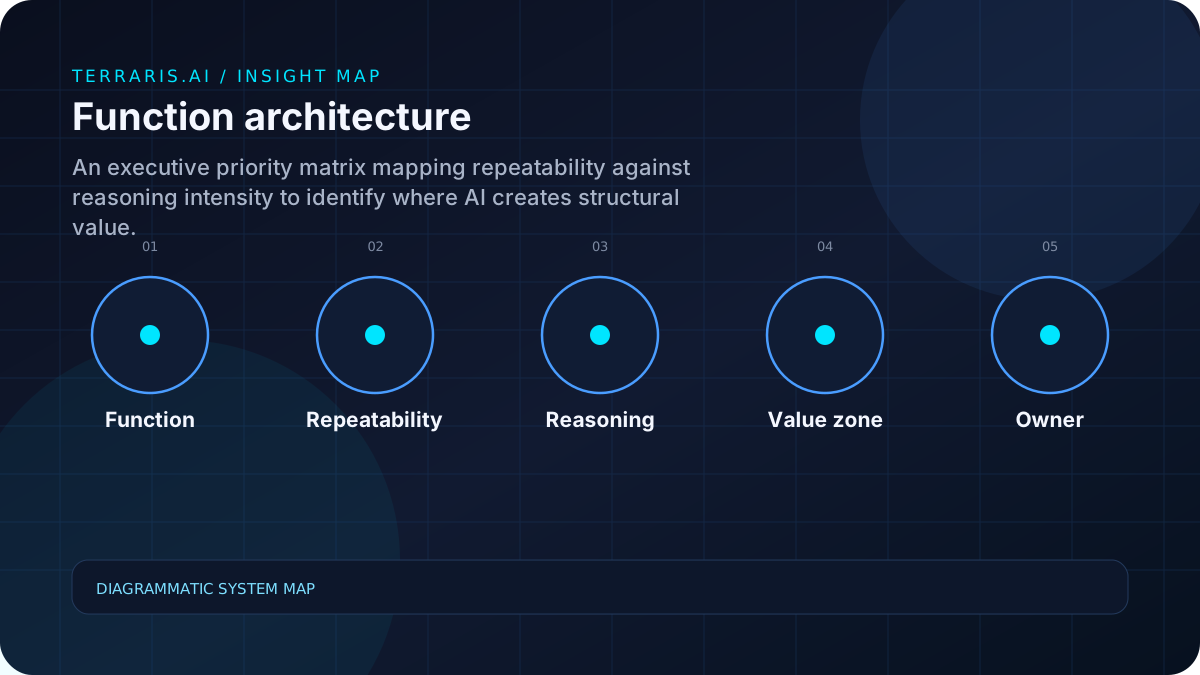
The entry point for executive AI strategy is not a technology audit. It is a process priority exercise, and the prioritization has a clear structure.
Two axes define the priority matrix: repeatability (how often does this process run, and how standardized is it?) and reasoning intensity (how much judgment is required at decision points?). The high-value quadrant is the intersection of high repeatability and significant reasoning requirement.
High repeatability without reasoning is automation, not AI. Low repeatability with high reasoning is a human expert problem, not an AI problem. The intersection — processes that run frequently and require real judgment at decision points — is where AI produces compounding value, because the investment in context engineering and process design pays off across every instance the process runs.
The examples are sector-independent: contract review and exception flagging, sales enablement for complex technical products, technical support requiring deep product and domain knowledge, financial analysis on recurring datasets, regulatory monitoring against evolving rules, supply chain exception handling that requires policy interpretation. Each runs repeatedly. Each requires judgment. Each rewards a well-designed AI layer.
The executive deliverable from the prioritization exercise is specific: a ranked list of three to five processes where AI redesign would produce the largest measurable improvement, with success metrics defined before any project starts. Not “improve efficiency” — a specific metric, a specific baseline, and a specific target that distinguishes success from activity.
The Headcount Question Done Right
“How many people can AI replace?” is the wrong framing for executive AI strategy, and it produces three bad outcomes: employee resistance that corrodes adoption, use case design optimized for elimination rather than capability, and regulatory and reputational exposure in labor-sensitive markets.
The right framing: before approving the next headcount addition, ask which portion of that role’s work can be handled by AI today. Not to eliminate the role, but to understand whether the new hire should be doing different work than the person who previously held the role did.
Alex Karp has introduced the concept of loadbearing AI: identifying the roles and functions in an organization that carry knowledge and process capability that the organization would lose if those people left. The strategic question for AI investment is not “what can we eliminate” but “what knowledge and capability should we invest in preserving and amplifying through AI systems, so the organization is less dependent on the continued presence of specific individuals.”
Organizations where critical knowledge lives in AI systems with human governance are structurally more resilient to turnover, scaling challenges, and market disruptions than organizations where that knowledge lives exclusively in people. This is the organizational resilience argument for AI investment, and it is more durable than the cost reduction argument.
The Governance Conversation at Board Level
The board conversation about AI is not primarily about opportunity. It is about what kind of organization the company intends to be when a significant AI decision goes wrong.
The governance questions boards should ask before approving AI deployment at scale are four:
What decisions is AI making, with what level of autonomy, and with what human oversight? The board does not need to select the models or design the systems. It needs to know the answer to this question, with specificity.
Who is accountable when an AI decision causes harm — a wrong credit determination, a discriminatory hiring filter, a hallucinated legal clause in a contract? Accountability must be assigned before the incident, not negotiated after it.
What is the incident response protocol, and is it documented today? When an AI system produces a harmful output, what happens in the first hour, the first day, the first week? If the answer is “we will figure it out,” the board has approved risk that has not been designed around.
Does the organization’s governance infrastructure meet the requirements of the regulatory environments the company operates in? For companies with operations in the EU, the AI Act’s high-risk classification applies to specific use cases regardless of the company’s size or the model vendor’s identity.
The companies that will be recognized as AI-First in five years are not the ones with the largest AI tool portfolios in 2026. They are the ones that redesigned how decisions are made, built governance infrastructure that earns trust with regulators and clients, and created the feedback loops that make AI systems better over time.
That is what AI-First actually means.
Terraris.ai helps executive teams map AI opportunities and build the process redesign and governance infrastructure that converts tool adoption into organizational capability. Start with an AI Opportunity Sprint.