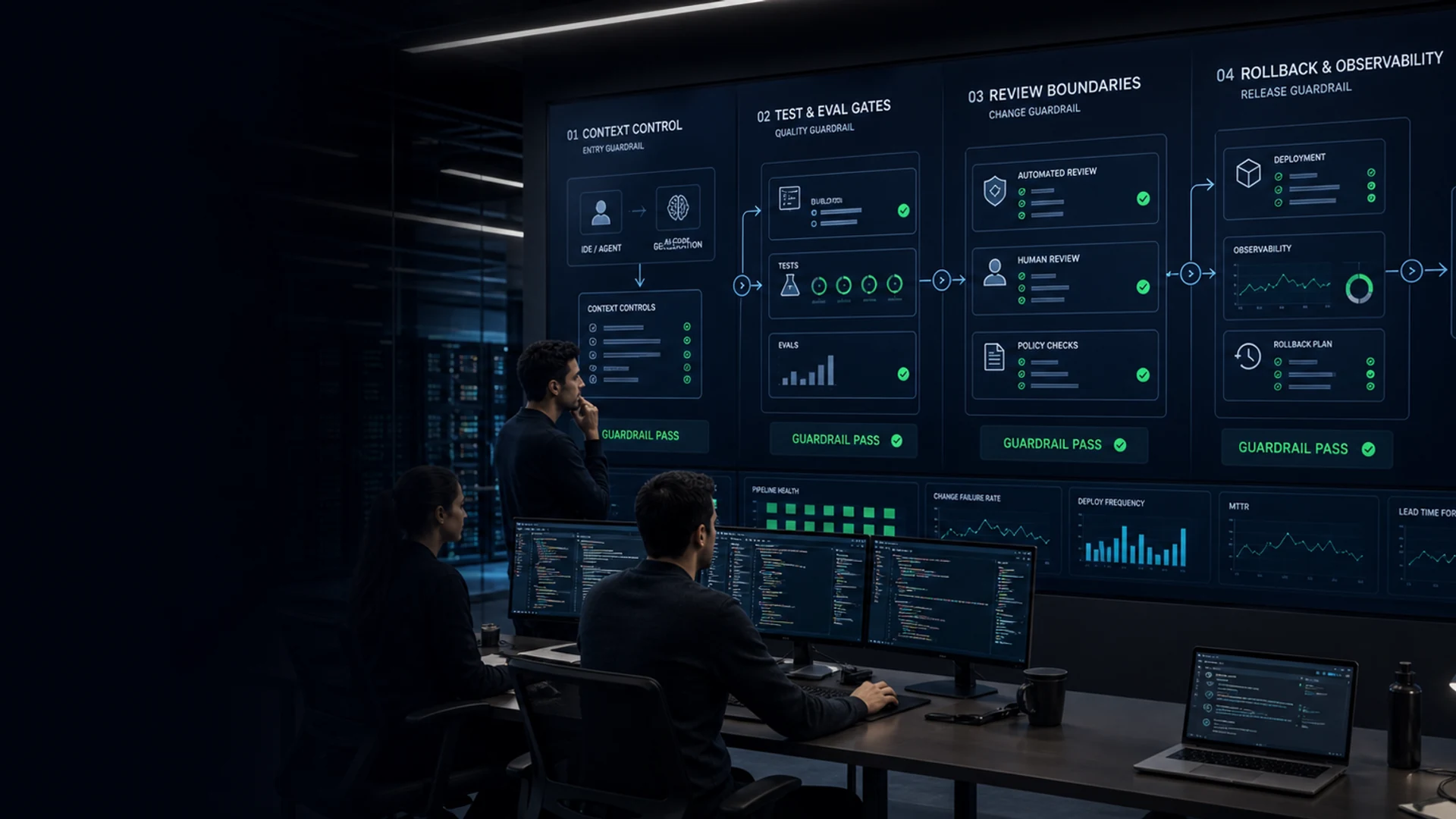
AI coding tools create a failure mode that experienced engineers recognize immediately and new practitioners discover painfully: the agent codes confidently, quickly, and wrong.
Not wrong because the model is bad. Wrong because no one forced it to clarify its assumptions before starting. Wrong because it chose a complex path when a simple one existed. Wrong because it touched files outside the stated scope, turned a two-file change into a twelve-file change, and made the review impossible to complete with confidence. Wrong because it delivered code it believed was correct without confirming the test suite agreed.
The fix is not a better model. It is engineering discipline, applied to agents as rigorously as to human engineers.
The Failure Pattern Nobody Mentions
There is a parallel in every engineering team’s history: the junior engineer who ships fast by skipping verification and touching everything nearby. The code works in isolation. The PR is enormous. Code review takes two hours and still misses something. The bug shows up two weeks later in a place nobody expected, because the change was too wide to trace.
AI coding agents exhibit this failure at scale and at speed. The agent is not malicious. It is not cutting corners. It is doing what it was told, in the way it seemed most complete, without constraints that would have bounded the work.
Guardrails are those constraints. They are not restrictions on capability. They are the conditions under which the agent’s speed becomes usable.
Think Before Coding
The first guardrail: the agent must surface its assumptions before writing code.
A request with ambiguity gets a question, not an interpretation baked silently into the first commit. Two reasonable approaches get an explicit proposal of the simpler one, with a request to confirm. A straightforward solution, when one exists, gets stated before a complex one is built.
The implementation is a single instruction in CLAUDE.md: for any non-trivial change, state the interpretation, propose the approach, and ask for confirmation before the first code block.
What this prevents is clear: hours of work based on a misread requirement that would have taken thirty seconds to clarify. Every senior engineer has had this conversation at the end of a sprint. The guardrail moves it to the beginning.
The engineering parallel holds. Senior engineers do not start typing immediately when a problem is described. They repeat the problem back, ask about constraints, confirm the success criteria. That behavior is not slowness. It is a discipline that makes the subsequent work faster.
Simplicity First
The second guardrail: the agent writes the minimum that solves the problem.
No unused flexibility. No single-use abstractions. No defensive code for scenarios not in scope. No refactoring of adjacent code that was not part of the request. The task description is a boundary, and the agent stays inside it.
The precise version of this principle: any addition beyond the stated scope requires explicit request. The agent that adds unrequested flexibility is not being helpful. It is making decisions that belong to the human. Architectural decisions, in particular, should not be made by the agent because they seemed reasonable in the moment.
What this prevents is feature creep from the coding agent. Code that is technically correct but architecturally bloated. Systems that grow in directions nobody decided to go, because the agent was being thorough.
The Definition of Done must be explicit in the task spec. “Implement the login endpoint” is not a definition of done. “Implement the login endpoint, returning 401 on invalid credentials, 200 on success, with a test for both cases” is.
Surgical Changes
The third guardrail: the agent touches only the files and lines required.
The failure mode is specific: the agent changes import ordering, renames variables, adjusts formatting, adds comments to code outside the stated scope, all in the same commit. The diff becomes unreadable. Code review becomes a reconstruction exercise. Merge conflicts appear across unrelated work.
The test for a clean change is direct: every modified line in the diff has a causal link to the stated requirement. If a line changed and you cannot explain why it was necessary, it should not be in the commit.
Worktree isolation enforces this structurally. When the agent works in its own branch, not on main, the diff is visible before any human review. The scope of the change is auditable before it is accepted. This is not a review convenience. It is a production-safety property.
The code review surface is a real cost. A two-hundred-line change that touches the right two hundred lines takes less time to review than a fifty-line change that touches fifty lines plus two hundred lines of unrelated cleanup. Surgical changes are not a stylistic preference. They are a throughput requirement.
Goal-Driven Execution
The fourth guardrail: the agent converts the request into a verifiable criterion and stops when that criterion is met.
Not “try to fix the bug.” “Reproduce the bug, implement the fix, run the relevant test suite, confirm the test passes, stop.”
The difference matters because agents that do not have explicit exit conditions continue improving things past the scope, or deliver code they believe is correct without confirming the test suite agrees. Both are expensive in different ways.
For bugs: reproduce first. A fix without reproduction is a guess. The agent that cannot reproduce the bug should say so before implementing anything.
For features: define the acceptance test before the first line of code. The test defines what done means. The agent runs toward the test passing, not toward some internal sense of completeness.
Monitoring the exit state is the human’s job. The review question is not “does this code look right?” It is “does the agent’s exit state match the agreed criterion?” Those are different questions with different answers.
How to Encode These in Your Project
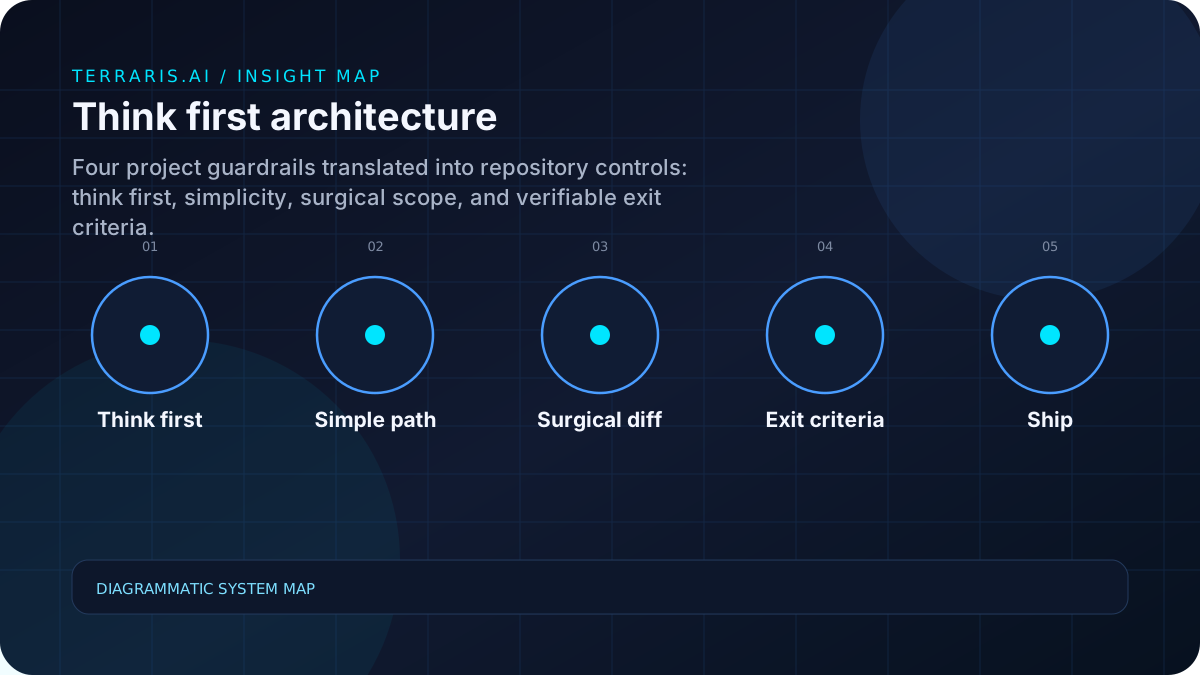
All four guardrails have concrete implementations. None require custom tooling.
A CLAUDE.md file with explicit behavior rules handles most of it: require interpretation + approach + confirmation before non-trivial changes; require explicit scope request for out-of-scope additions; require that every changed line be causally necessary; require that every task include a verifiable exit condition.
Skills, reusable slash commands built into the project, reinforce the guardrails without relying on the developer to remember them session by session. A scope-check skill that asks the agent to list every file it plans to touch before touching any of them. A verify-before-commit skill that runs the test suite and reports the result before the commit message is written. A definition-of-done template that forces the developer to write the acceptance test before assigning the task to the agent.
The compound effect is measurable. A project that encodes these guardrails develops faster than one without them, because rework decreases as confidence in agent output increases. The first session with guardrails may feel slower. By week three, the teams without guardrails are paying debt that the teams with them have not accumulated.
There is also a team dynamic worth noting. Guardrails make code review tractable. When the diff is surgical and the exit criterion is explicit, reviewers know what to look for. Review time drops. Merge latency drops. The compound effect on cycle time is larger than any single guardrail produces on its own.
The organizational pattern that works: introduce all four guardrails in the first sprint, not one at a time. The guardrails interact. A goal-driven execution without simplicity first still produces bloat. Surgical changes without think-before-coding still produces the wrong thing, precisely. All four together create a closed loop where the agent stays in scope, confirms its interpretation, makes minimal changes, and stops at a measurable criterion.
These guardrails are not restrictions on the agent. They are the conditions under which the agent’s speed becomes an asset rather than a liability. Speed without discipline accumulates faster than it ships. Speed within guardrails ships.
The CLAUDE.md file in your repository is the enforcement mechanism. If it does not specify what the agent should do before writing code, the agent will make that decision on its own.
Related: Claude Code Is Not a Copilot. It Is a Delivery System. and Vibe Coding Is a Prototype Strategy, Not a Production Strategy