A financial services firm deploys a document analysis system. Scope defined, system built, handover completed. Twelve months later, the model provider updates the underlying model. The prompts that produced clean structured outputs now produce inconsistent formatting. The document corpus has grown by forty percent, including new document types that were not in the original training set. Three integrations have changed their authentication schemas.
Nobody is maintaining the system. The team that built it has moved on. The firm’s internal staff inherited a black box.
This is the default trajectory of project-based AI delivery. Not a visible failure at handover. A slow degradation that compounds until remediation costs more than an ongoing relationship would have.
The Project Trap
The project model works for systems that are static once delivered. A database migration produces a migrated database. A website redesign produces a redesigned website. The delivered artifact is the product.
AI systems are not static.
The models change, sometimes without announcement. The document corpus ages, as new policies supersede old ones and the original ingestion falls behind. The business processes the AI supports evolve, creating new edge cases the system was not designed to handle. Regulatory requirements shift, and the system continues operating under the rules that applied at build time. The APIs and external systems the AI connects to change their schemas, their authentication, their data formats.
A project-built AI system without ongoing governance is a system on a degradation trajectory from the day it is delivered. The degradation is often invisible: the system continues producing outputs, but the outputs are increasingly wrong in ways that are hard to detect without an evaluation harness. The visible failures surface eventually, but by then the cause is buried in months of accumulated drift.
The project model is the right model for a lot of software. It is the wrong model for systems whose quality depends on a dynamic relationship between the system, the data, the models, and the business processes the system serves.
What Degrades Without Ongoing Ownership
Five decay vectors accumulate in unmanaged AI systems.
Corpus staleness is the most common. Documents added to the organization’s knowledge after the initial ingestion are not retrieved by the RAG system. The system’s answers become increasingly incomplete as the corpus it queries falls further behind the corpus the organization actually uses. In a fast-moving domain, this is a critical failure within six months.
Prompt drift is less visible but equally damaging. Model providers update the underlying models continuously. The prompts calibrated for one model version may produce degraded outputs on the next. Without a regression test protocol, these changes go undetected until a user reports an anomaly.
Edge case accumulation happens as the system encounters queries or documents it was not calibrated to handle. Without a feedback loop that surfaces these cases and routes them back into the prompt or the retrieval layer, they accumulate as silent failures. The system handles them poorly, consistently, without correction.
Regulatory drift affects any AI system operating in a compliance-sensitive environment. The rules change. The system does not. The outputs continue to reference requirements that have been superseded.
Integration rot is the most abrupt failure mode: an API the AI system depends on changes its schema or authentication method, and the system breaks. With ongoing oversight, this is a one-day fix. Without it, the system is down until someone investigates, and nobody is monitoring it.
The failure pattern is consistent across these five vectors: the system looks functional, produces outputs that appear plausible, and degrades in ways that are only detected when a visible failure forces investigation. By that point, the remediation effort, including the investigation to identify causes, is significant.
The Retainer Model Architecture
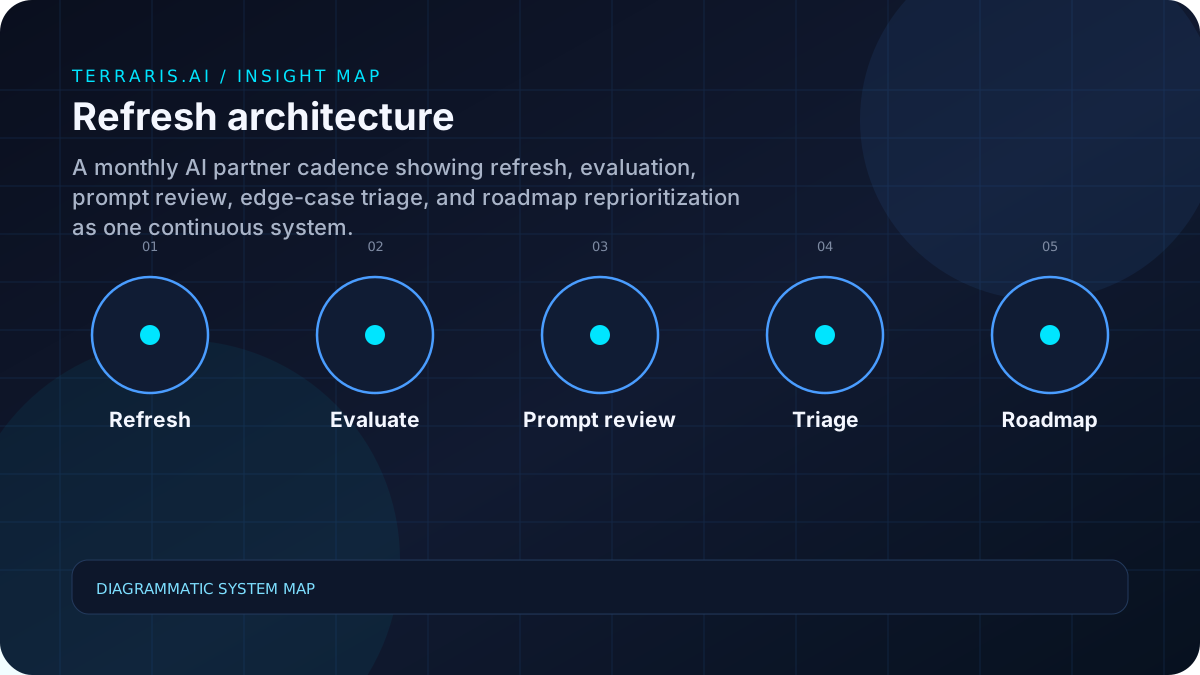
The AI Partner Retainer is not a support contract. It does not wait for something to break. It is an ongoing delivery relationship with a defined cadence of improvement.
Monthly deliverables in a well-structured retainer: corpus refresh, where new documents are ingested and stale documents are flagged for owner review. RAGAS evaluation harness run, where the four quality metrics are compared against the established baseline and any regressions are investigated before they reach users. Prompt review, where prompts are updated for model changes and new edge cases that emerged during the month. Integration health check, where connected systems are verified against the expected schemas. One improvement sprint, delivering one new capability or one significant quality improvement from the prioritized backlog.
Governance deliverables: a monthly quality report to the decision owner, presenting the RAGAS scores, the corpus status, the improvement delivered, and the risks identified. A quarterly risk review covering regulatory changes in the relevant domain. An annual architecture review assessing whether the system design still fits the organization’s current needs.
The distinction from project work is deliberate. The retainer explicitly includes improvement, not just maintenance. The backlog of improvements is owned jointly by the partner and the client. The relationship is structured to produce a system that compounds in capability over time, not one that holds at the level of the initial delivery.
The Commercial Sequence That Makes Retainers Work
Retainers rarely sell from a cold conversation.
The client needs to have seen the partner deliver something concrete before committing to an ongoing relationship with a named cost. That requires a working system in production. The production system requires a scoped first project. The scoped first project requires a discovery sprint that establishes the problem, the value, and the technical feasibility.
The sequence: a paid discovery sprint validates the problem, scopes the first system, and produces a value estimate. The first project delivers a narrow, governed system in production with the evaluation instrumentation in place. The retainer maintains and improves the production system with ongoing delivery.
The sequence matters because the retainer requires trust, and trust requires a proof point. A client who has seen a partner deliver a system that works, report honestly on its quality, and respond competently to the first post-launch issues has the evidence needed to extend the relationship. A client who has not seen any of that is buying a promise.
The qualification filter works in both directions. Clients who are unwilling to pay for discovery are signaling that they do not value the structured approach that produces reliable outcomes. Clients who want to skip to a retainer without a production system first are describing a consulting relationship, not an operational partnership. Neither is a good candidate for a retainer that will produce compounding value.
Pricing structure in the retainer model is scoped by process complexity and improvement velocity, not by hours. The client buys a capability that maintains and improves their system. The price reflects the operational value of that capability, not the cost of the hours consumed.
The Delivery Manager as the Retainer’s Load-Bearing Role
Technical quality is necessary for a retainer to function. It is not sufficient for a retainer to survive.
What kills retainers is not poor system performance. It is invisible progress. The client does not know what was done this week. Scope creep accumulates without acknowledgment. The partner disappears between deliveries and reappears at the monthly review with a summary that the client cannot evaluate. Escalation paths are unclear.
The delivery manager role is the mechanism that prevents these failures. The delivery manager maintains the weekly cadence of communication: what was done this week, what is planned next week, any risks or blockers, any metrics that moved, any decision needed from the client. The communication is in business language, not in engineering language. The RAGAS score improvement is translated into what it means for the queries that matter to the decision owner.
The delivery manager owns the scope of work and flags changes before they happen. Any work outside the defined scope is identified as a scope question, not absorbed silently or refused without explanation. The client is involved in the decision about whether to add scope, adjust scope, or defer.
The weekly update format is not overhead. It is the mechanism by which technical work converts to client confidence. A client who receives a consistent, honest, legible weekly update for six months has evidence that the partner is managing the engagement with discipline. That evidence is what justifies renewing the relationship.
Retainer as Competitive Infrastructure
The retainer is not primarily a revenue model for the AI partner. It is a competitive infrastructure investment for the client.
An organization with an ongoing AI partner accumulates a system that is progressively better calibrated to their specific processes, data, and edge cases. The eval harness captures the failure modes specific to their domain. The corpus reflects their current knowledge, not the knowledge they had at the time of the initial deployment. The prompts are tuned to the queries their users actually ask, not the queries that seemed most likely in the discovery sprint.
An organization that uses project-based AI delivery gets a system well-calibrated at the moment of delivery and slowly wrong thereafter. The model providers advance. The knowledge base ages. The edge cases accumulate. The system that was a competitive asset at launch becomes a liability that requires emergency remediation every time a visible failure surfaces.
The compounding advantage is structural. An AI system in its third year of retainer has been through multiple model updates, hundreds of edge case corrections, several corpus refreshes, and at least one significant capability addition. It is a meaningfully more capable system than what was delivered in year one, and it is calibrated to this specific organization in ways that cannot be replicated quickly by a competitor with a newer model.
The switching cost is earned through investment, not through contractual lock-in. A client who has invested three years in corpus quality, evaluation harness development, and integration depth has built something that is genuinely difficult to replicate. That is the durable competitive advantage that AI is capable of producing, and it requires an ongoing relationship to accumulate it.
Terraris.ai structures its engagements as the commercial sequence described here: discovery sprint, production system, retainer. If you are evaluating how to structure an ongoing AI relationship for your organization, start with how we approach the first engagement.